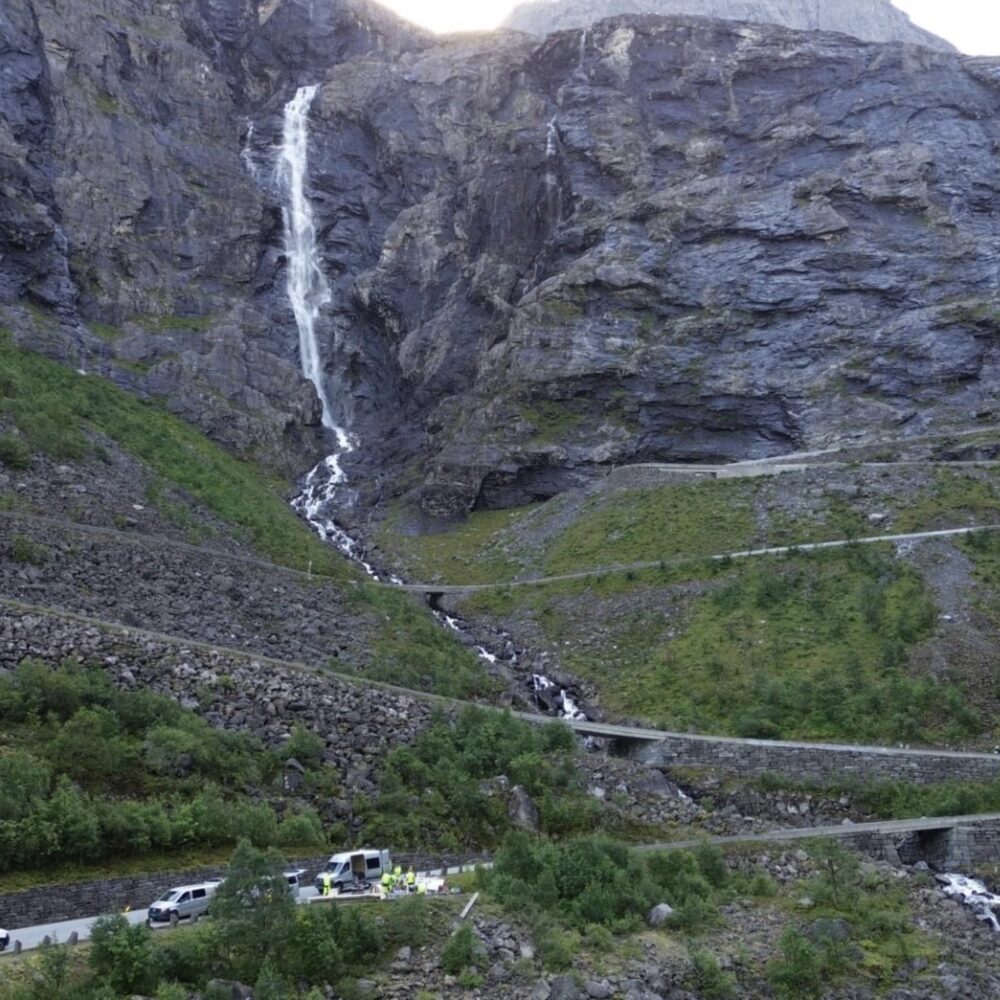
Avalanche protection for Heggtveitjuvet in Telemark

Cautus Geo establishes continuous monitoring with automatic avalanche warning in Tokke.
18. 18 August 2022
Written by Rino Andersen
Cautus Geo is establishing continuous monitoring with automatic avalanche warning from Heggtveitjuvet in Tokke municipality. The system protects road users on the county road along Byrtevatn. It will be put into operation in the autumn.
Heggtveitjuvet is narrow. It is surrounded by Rautefjell at 1,360 metres and Grasnuten at 1,254 metres. There, the snow masses travel at a speed of 40 metres per second down the mountainsides. The avalanches occur annually. Not all landslides reach the county road, but in February 2014 the snow masses stopped 100 metres out on the then-iced Byrtevatn. The county road was then covered in a thick layer of snow.
In 2020, six landslides came thundering down the gorge, named Heggtveitrøti in the Norwegian Public Roads Administration's landslide hazard report. That year, the road was closed nine times after landslides. The largest landslide that year occurred on 24 February. It stopped 30 metres before the roadway. Climate change increases the risk of more frequent landslides.
- "Increased precipitation and more wind increase the frequency of landslides," says Tore Humstad of the Norwegian Public Roads Administration.
New radar system
Cautus Geo will install a brand new radar-based system. It provides continuous avalanche monitoring that automatically alerts and closes traffic in the event of an avalanche. The system will also automatically reopen the road if the avalanche does not reach the carriageway.
- "We suggested switching from geophone to radar technology. That way, landslides can be signalled earlier. This increases safety. In addition, the roadway can be automatically reopened after a few minutes if the avalanche does not reach the roadway," says Humstad.
The system replaces the country's oldest geophone-based warning system, which is still in operation. It was established back in 1995.
- The plant is old. We're struggling to get hold of spare parts and after landslides we have to carry out manual inspections to reopen the road. It's cumbersome and time-consuming," says geologist Audun Langelid from Vestfold and Telemark County Council.
Securing the school route
- The daily traffic on the county road is 100 cars. Of these, the school bus passes the site every day, which is now secured with modern technology that will warn of landslides earlier and also ensure shorter closure times when landslides do not reach the road surface," says construction manager Jon Geir J. Olsen of Vestfold and Telemark County Council.
Last winter, landslides, even when they didn't reach the county road, could close the road for up to five quarters of an hour. With automatic reopening, the closure time will be reduced to a few minutes.
- Avalanche notifications are sent to avalanche experts, contractors, the Road Traffic Centre, regObs and the Natural Hazards Portal. In addition, information about landslide events is available in Cautus Web," says Lars Krangnes of Cautus Geo.
Five-year contract
The avalanche monitoring system that Cautus Geo has been commissioned to install will operate from November to May, which is defined as the avalanche period for snow.
The warning system consists of radar, cameras, Cautus Web, lighting systems for closing traffic, automatic reopening when spoil does not reach the road surface and a notification system with SMS and e-mail to the operating contractor and the county council.
- We're replacing the old geophone system with our most modern radar-based system," says Krangnes.